Development Intensive Talk March2026
Good morning. I'm Auriea Harvey. I started making art on the internet in the nineties, then designed games, and for the last few years I've been making sculpture from software. I model a form digitally, and then it has to become an object. That step is where this research begins.
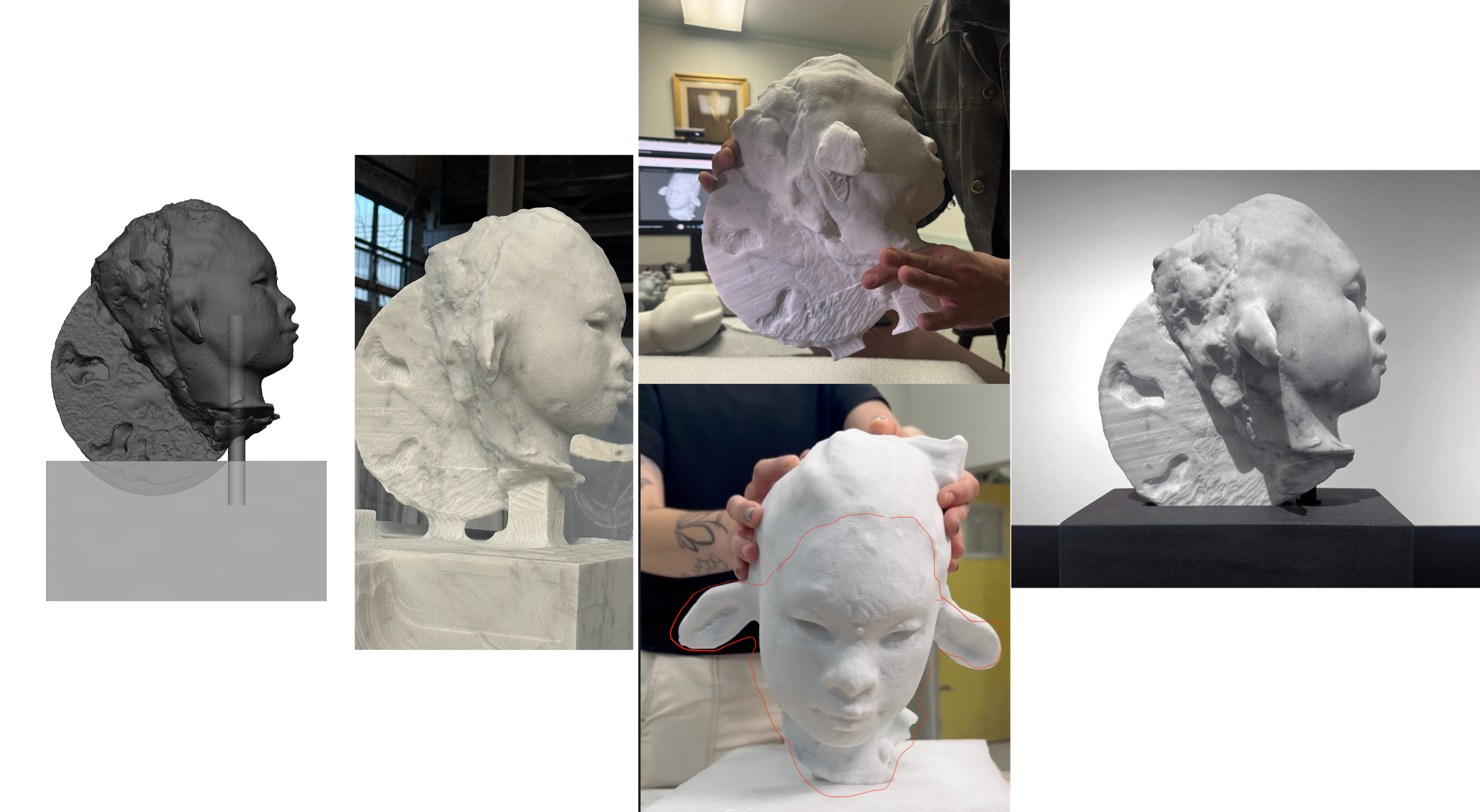
I've now had three major experiences of fabrication. The first was my first marble piece, made by Monumental Labs in New York. I never saw it or touched it, and when they asked me what I wanted, I didn't know how to answer. I didn't speak the language of stone.
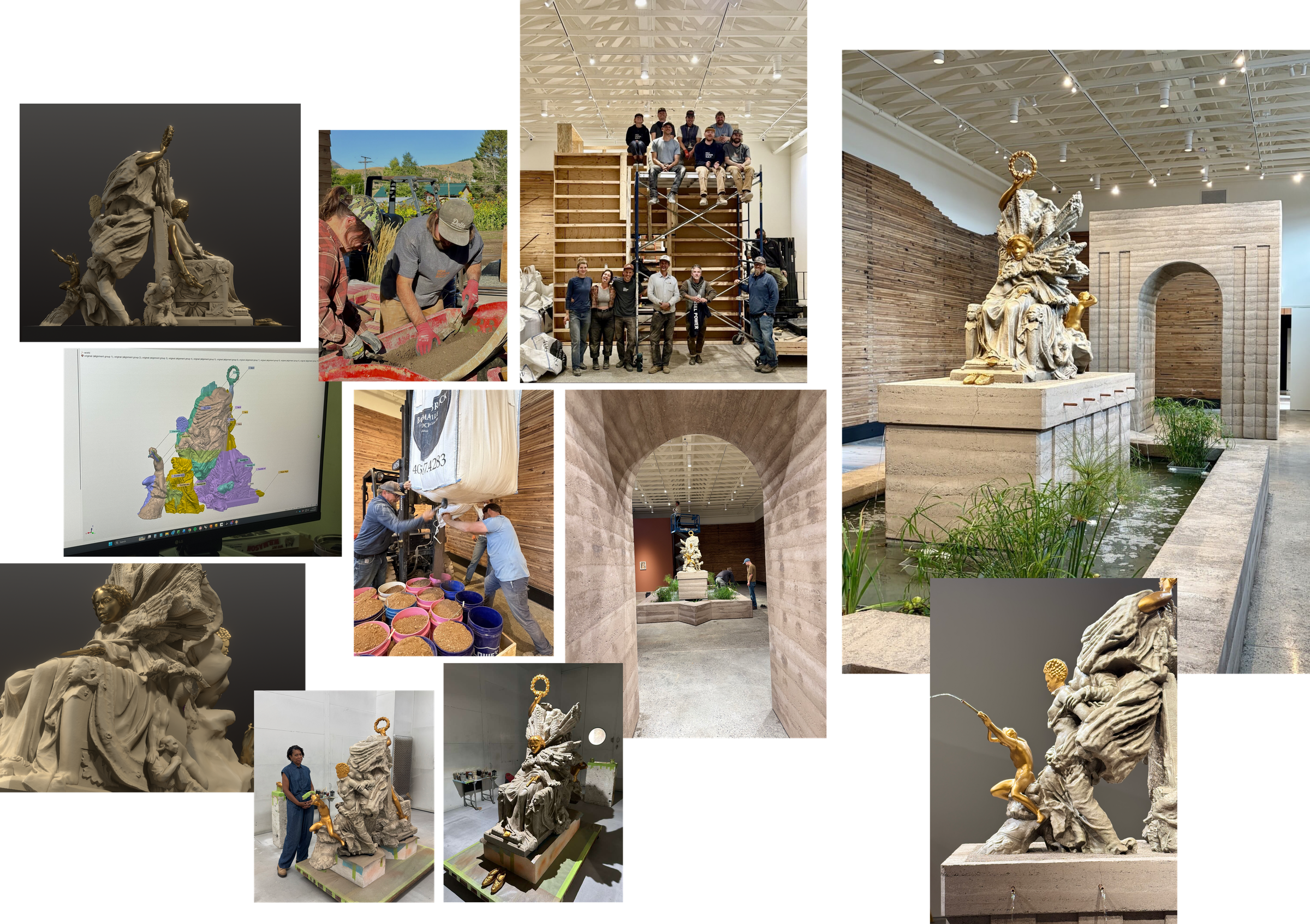
The second was Edmonia Triumphalis. The figure was made by Johnson Atelier, at factory scale, and the cost and weight meant I had to compromise on the material: urethane foam with a hard coat, not stone and bronze as I'd wanted. But the installation itself, in Bozeman, Montana, was different. Tinworks Art commissioned it, and with Montana State University, a local architect and a producer on their team, a whole community built it. I wasn't there, and I still felt part of it.
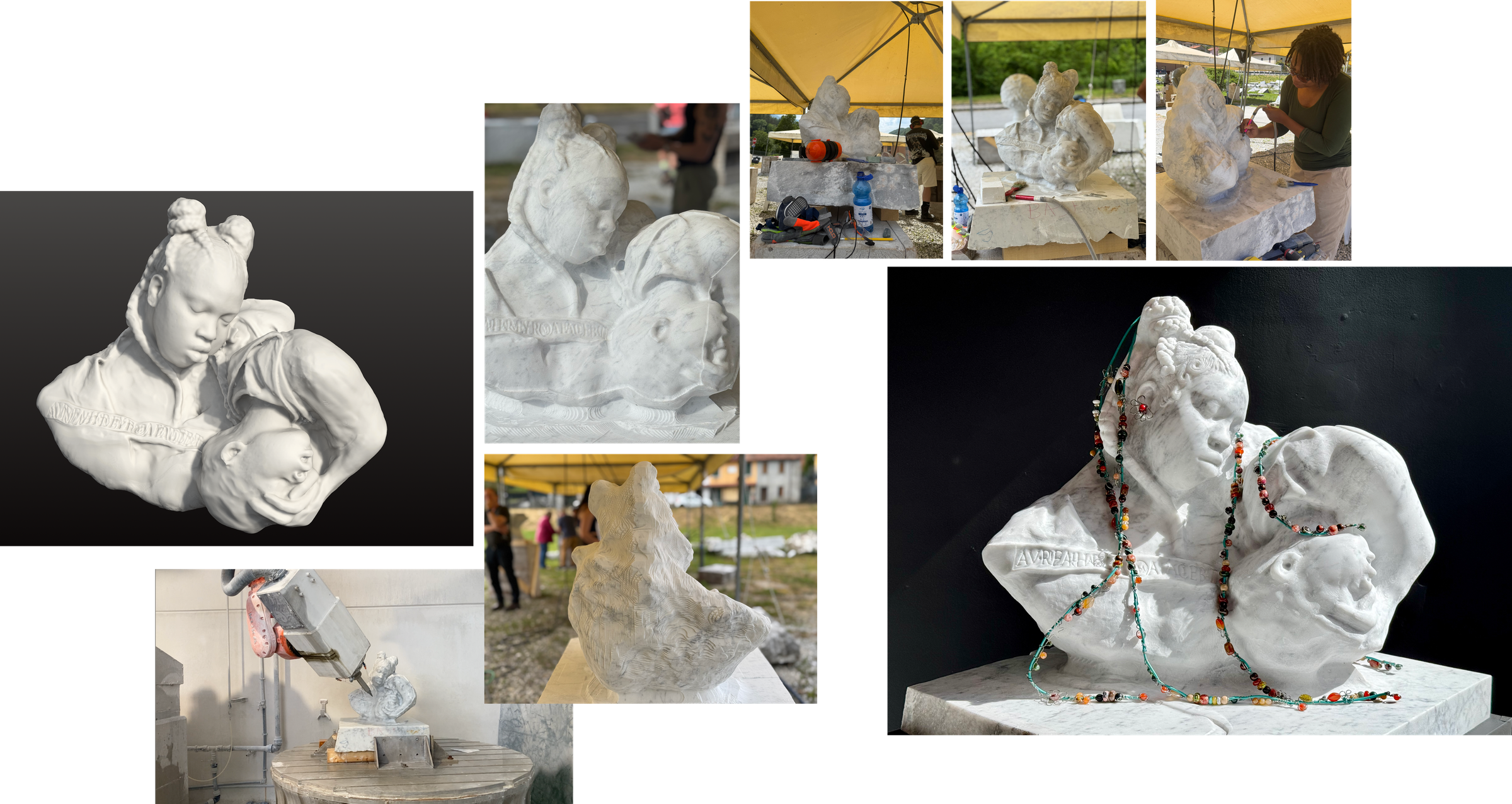
The third was Mother Child, milled by robot at the Digital Stone Project in Garfagnana, in Tuscany, and finished by hand. I was there, and I touched it. Working the marble myself is where I learned the language of stone, and it's where the questions behind this research began. It's also where I wrote my first apps, Tincture, Metope and Spolia.
So my question is this: what if software could carry that knowledge between an artisan and me, so a form made here can be made by many hands somewhere else?
How can sculptors today collaborate and fabricate differently? My proposal is to use AI as a translation layer between digital craft and handcraft, so a form made in one place can be made by many hands in another, as true collaborators and not clients and vendors. My guiding principle is that human judgment must direct the tool, never the other way round.
The research lives in a wiki, built around seven questions. Some pages are still in progress. I'll take you through four.
First, the file. For me the file is the artwork. It's the model I spend months shaping, and every object comes from it. The figure for Edmonia Triumphalis was a file before it was anything else. It's also the least valued part of the art world: people want the marble or the bronze and treat the file as a receipt. And 3D AI is moving into exactly that place, the making of 3D forms. So I have to watch it closely, as a tool, not as a replacement.
Second, the hands. I've been saving makers on Instagram for years: 33 posts from 29 accounts, clustered in Italy, Egypt, Iran and South Asia, and almost nothing in Latin America, Africa or East Asia. So I went looking further and put them on a globe. to the wiki and turn the globe. The strongest lead is Benin City, where a lost-wax guild could cast directly from a wax printed from my file. None of these people have been contacted yet. This is a map of who I'd like to meet.
Third, institutions. I don't yet know which ones, and I'm trying to start from what I can give them, not what I want from them.
This is the hardest part of the research. The question isn't whether an institution will host a work, it's what role it should play. I see three models. A host shows the work where it was made. A co-producer funds and arranges the making. A broker connects me to local fabricators and then steps back. Which would you trust, and what would make each one extractive? I'll put that to the roundtable tomorrow.
Last, what is best for humanity. My guide is the encyclical Magnifica Humanitas, Pope Leo XIV on AI and humanity. I can't summarize it in a minute. What I hold onto is that human conscience and judgment must remain the ones directing any technical process. In practice that means a maker should never have to become a technician for this to work.